

SMT Tombstoning in High-Density PCB Assembly

In SMT assembly, tombstoning is a well-known defect where a chip component lifts from one side during reflow soldering and stands vertically or at an angle. Although it looks simple, it is actually the result of multiple design and process imbalances happening at the same time.
In real production, tombstoning is rarely caused by a single factor. More often, it starts from PCB layout decisions made at the design stage.
What Is Tombstoning in SMT?
Tombstoning occurs when one end of a surface-mount component lifts off the PCB while the other end remains soldered during the reflow process.
It is most common in small passive components such as resistors and capacitors, especially in 0402 and 0201 packages. At this scale, even very small differences in force or heat distribution can determine whether the component stays flat or rotates upward.
The root cause is an imbalance of forces generated by molten solder on both pads.

Key Causes of Tombstoning
One of the most common technical misunderstandings is that tombstoning is only related to reflow or solder paste. In fact, pad design geometry and spacing are often the starting point of the problem.
If the two pads are not properly designed with balanced spacing and equal contact area, the wetting force will never be symmetrical.
A typical case is when the pad spacing is too large. In this situation, the component only overlaps a small portion of each pad. This reduces the effective solder contact area and makes the wetting force unstable. During reflow, one side may gain enough force to pull the component before the opposite side fully reacts, resulting in tombstoning.
The same issue can also happen when one pad has significantly more solder coverage than the other due to poor footprint design. Even if the stencil printing is perfect, the imbalance already exists at the layout level.
Thermal imbalance is another major contributor. When one pad is connected to a large copper plane and the other is not, the heating speed becomes uneven. The side that reaches reflow temperature first generates stronger wetting force earlier, pulling the component upward.
Solder paste printing variation can further amplify this imbalance. Even small differences in paste volume between the two pads can change the timing and strength of wetting forces.
Component placement accuracy also plays a role, especially for very small chip components. If the component is slightly shifted away from the center line of the pads, the already weak balance becomes even more unstable during reflow.
Finally, smaller component sizes naturally increase sensitivity to all of the above factors because their weight is too low to resist surface tension forces.
How to Reduce Tombstoning in Real Production
From a manufacturing perspective, preventing tombstoning requires addressing the issue at multiple stages, starting from PCB design.
The most important step is to ensure that pad geometry and spacing are correctly designed at the DFM stage. Both pads should have equal or near-equal contact area, and the component should be fully supported without excessive spacing. If the spacing is too large and the component only “barely touches” the pads, the risk of tombstoning increases significantly even if all other parameters are well controlled.
Thermal balance should also be considered in PCB layout. Avoid connecting only one pad to large copper areas without thermal relief design, as this creates uneven heating during reflow.
In stencil design, controlling paste distribution is important, but it should be seen as a secondary adjustment rather than a primary fix. If the footprint itself is unbalanced, stencil optimization alone will not fully solve the problem.
Reflow profile tuning helps synchronize solder melting between both pads. A stable soak stage is particularly important for allowing temperature equalization across the PCB.
Finally, accurate placement and process stability ensure that no additional imbalance is introduced before reflow begins
Why This Is More Critical in High-Density and Flexible PCB Designs
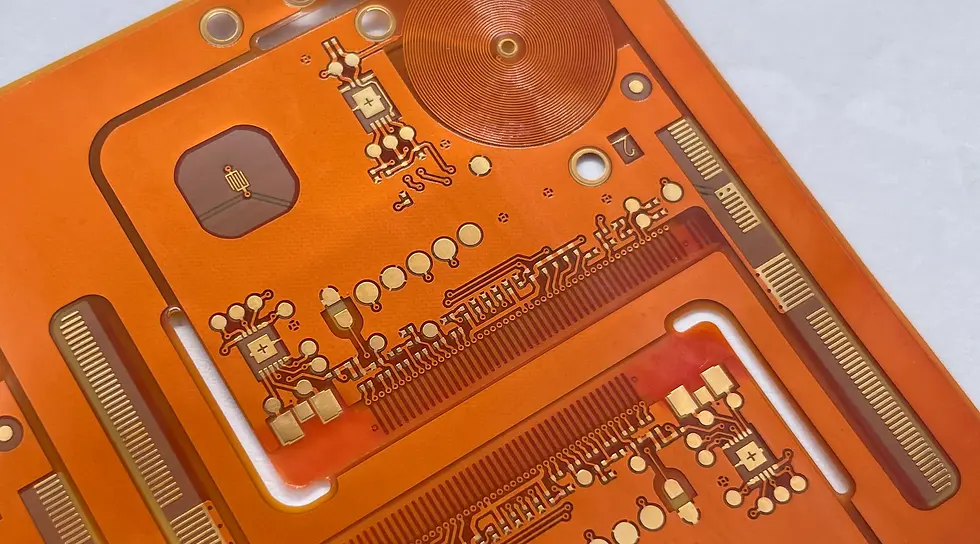
In flexible PCB and rigid-flex PCB designs, tombstoning risk is even higher due to mechanical and thermal differences compared to rigid boards. Thin substrates and flexible structures tend to amplify heat imbalance, making pad design even more critical.
This is why in high-density interconnect applications, DFM review is not optional—it directly affects yield.
Conclusion
SMT tombstoning is not just a process issue. It often originates from PCB layout decisions, especially pad spacing, symmetry, and thermal design.
Once the pad design is correct and balanced, most downstream process adjustments become significantly more effective. Without that foundation, even perfect soldering conditions cannot fully eliminate the risk.


Comments