

Pressed Pad vs Open Pad in Flexible PCB Design

In flexible PCB design, one small detail can quietly determine whether your product survives real-world use or fails after assembly: pad coverage.
At the same time, this is also one of the most common issues we help customers optimize during flexible PCB prototyping and manufacturing—especially in applications involving bending and high reliability requirements.
The choice between pressed pad (coverlay overlap) and open pad (non-covered pad) directly affects solderability, peel strength, and long-term reliability—especially in applications involving bending, vibration, or repeated insertion.
What Is a Pressed Pad in Flexible PCB?

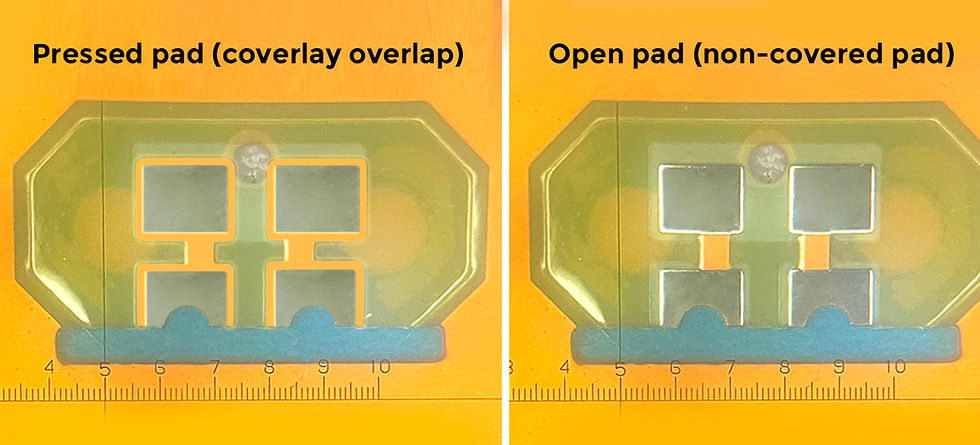
A pressed pad refers to a structure where the coverlay partially overlaps the copper pad edge.
Instead of fully exposing the pad, the coverlay opening is equal to or slightly smaller than the pad, allowing the adhesive and film to “anchor” the copper.
Key Characteristics:
Coverlay overlaps pad edges
Smaller or tight opening window
Often used with reinforcement or stiffeners
Engineers select it because it improves peel strength, prevents pad lifting, and enhances reliability in dynamic flex areas.
What Is an Open Pad (Non-Covered Pad)?
An open pad means the coverlay opening is larger than the pad, leaving the copper fully exposed.
This is closer to standard rigid PCB solder pad design.
Key Characteristics:
Pad fully exposed
Larger opening than copper
No mechanical anchoring from coverlay
Features such as maximized solder wettability, easier assembly and rework, and higher manufacturing yields lead engineers to select it.
Pressed Pad vs Open Pad
Factor | Pressed Pad | Open Pad |
Solderability | Moderate | Excellent |
Mechanical Strength | High | Low |
Peel Resistance | Strong | Weak |
Risk of Pad Lifting | Low | High |
Process Complexity | Higher | Lower |
Rework Difficulty | Harder | Easier |
The Real Engineering Trade-Off
This is not just a design preference—it’s a physics problem:
Open pads favor soldering
Pressed pads favor reliability
If your flexible PCB never bends, open pads are fine.
If your flex PCB moves, flexes, or gets stressed, open pads can become a failure point.
When to Use Pressed Pads
Use pressed pads when mechanical stress is a concern:
Typical Applications:
Connector interfaces
Repeated bending areas
Wearables and medical devices
Automotive and aerospace electronics
Long, thin pad geometries
Why It Matters:
In flex applications, copper adhesion becomes critical. Without support, pads can delaminate under stress, even if soldering looks perfect.
When to Use Open Pads
Use open pads when assembly performance is the priority:
Typical Applications:
SMT component pads (ICs, resistors, capacitors)
Test points
Static, non-flex zones
High-volume production lines
Why It Works:
Open pads help improve solder flow and reduce the risks of cold joints, insufficient wetting, and assembly defects.
Common Design Mistake (and Why It Fails)
Many designers apply rigid PCB logic to flexible PCB: “Fully open pads = best soldering = best design”
That assumption ignores one key difference: Flexible PCBs move. Rigid PCBs don’t.
In flexible environments, this practice often leads to pad lifting after bending, solder joint cracking, or field failures following deployment.
In real projects, we often see these issues caused by incorrect pad design or improper coverlay opening settings. Our engineering team typically reviews Gerber files and suggests optimized pad structures before production to prevent these risks.
Best Practice: Hybrid Pad Design Strategy
Experienced flexible PCB manufacturers rarely use a single approach across the entire board.
Instead, they apply a hybrid design strategy:
Optimized Approach:
Open pads → for SMT areas
Pressed pads → for stress zones
Reinforcement → where needed
Advanced Techniques:
Teardrop pad transitions
Local coverlay optimization
Stiffener + pressed pad combinations
This strategy strikes a balance between assembly efficiency, mechanical durability, and long-term reliability.
Design Recommendations (From Manufacturing Perspective)
To avoid costly redesigns, consider these guidelines early:
Define dynamic vs static zones in your layout
Avoid open pads in bend areas
Use pressed pads for elongated or thin pads
Coordinate coverlay opening tolerances with your manufacturer
Validate with peel strength and bend testing
Final Thoughts
If you're working on a flexible PCB project and are unsure whether to use pressed pads or open pads, it's worth validating the design before production.
You can share your Gerber files or design requirements with our team—we’ll provide manufacturability feedback and optimization suggestions based on real production experience.
We support both flex PCB prototyping and mass production, including complex structures like partial coverlay overlap, stiffener integration, and high-reliability applications.


Comments