

FPC Dry Film Etching & Imaging : How to Prevent Open and Short Circuits

The most effective way to prevent open and short circuits during FPC dry film imaging and etching is to implement tightly controlled pre-treatment, anti-wrinkle dry film lamination, calibrated UV exposure, standardized development breakpoints, and low-undercut etching. Targeted process tuning for thin polyimide substrates and ultra-thin copper foil can eliminate over-etching, photoresist residue, light scattering and lamination voids—the four root triggers of mainstream flexible circuit defects.
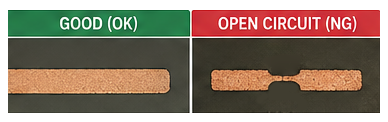
Dry film imaging and etching are core pattern transfer procedures for flexible PCB manufacturing. Compared with rigid PCBs, FPCs adopt PI substrates and 5–12μm ultra-thin rolled copper, making fine-line traces extremely susceptible to open and short circuits caused by minor process fluctuations. Uncontrolled defects lead to board scrapping, repeated rework and increased production costs, which severely affects mass production yield.
Unique FPC Challenges in FPC Dry Film Etching
Open and short circuits occur far more often on flexible circuits due to inherent material and design characteristics, which differentiate flexible PCB manufacturing from conventional rigid PCB production:
Delicate PI Substrate: Polyimide is sensitive to high temperature, uneven pressure and aggressive chemicals, easily generating deformation, wrinkling and dry film delamination.
Ultra-Thin Copper Foil: High-end FPC thin copper layers are prone to physical scratches and over-etching, which directly creates broken traces without precise parameter control.
Dense Fine-Line Design: Narrow 20–50μm line/spacing for wearable and foldable devices cannot tolerate photoresist residue or light scattering, which directly causes conductive bridging.
Bending Durability Demand: FPC traces require smooth side walls with low undercut; severe side etching not only produces open circuits during production but also causes trace fracture in bending reliability tests.
Process Optimization to Prevent Open Circuits
FPC open circuits mainly stem from poor dry film adhesion, lamination damage and over-processing across pre-treatment, lamination and exposure & development stages. Below are refined and non-repetitive optimization strategies:
Pre-Treatment: Balance Roughness and Protect PI Substrate
Qualified copper surface pretreatment guarantees stable dry film adhesion while avoiding damage to thin FPC substrates:
Optimize Micro-Etching Depth: Maintain micro-etching thickness at 0.8-1.2 μm to form an adhesive-friendly rough surface; avoid strong corrosive reagents to prevent PI swelling and ultra-thin copper over-thinning.
Low-Temperature Drying: Set baking temperature within 60–80°C to stop thermal shrinkage and warpage. Completely remove water stains to eliminate micro-bubbles formed after lamination, a common hidden cause of broken traces.
Low-Stress Cleaning: Adopt soft spray instead of high-pressure flushing to prevent copper foil peeling off the polyimide base.
Dry Film Lamination: Eliminate Wrinkles and Voids
Lamination contamination and wrinkles are the top causes of sporadic FPC open circuits. Adjust rigid PCB lamination parameters to fit flexible substrates:
FPC-Specific Parameters: Appropriately reduce roller temperature and lamination pressure to prevent copper crushing and PI wrinkling, and eliminate voids on bent areas of single/double-sided flexible boards.
Purity Working Environment: Apply Class 10000 cleanroom standards for lamination workshops. Dust and fibers trapped under dry film will form permanent trace notches after etching, and FPCs cannot be repaired via grinding like rigid boards.
Static Removal: Equip lamination devices with static eliminators to reduce dust adsorption and localized adhesion failure on charged FPC substrates.
Exposure & Development: Avoid Photoresist Deterioration
Routine Photomask Maintenance: Regularly clean and replace scratched DDF photomasks to avoid incomplete dry film exposure, which creates unprotected copper traces and open circuits after development.
Prevent Over-Development: Stabilize Na₂CO₃ developer concentration, temperature and line speed to avoid excessive erosion on thin dry film edges and subsequent film delamination.
Process Optimization to Eliminate Short Circuits
FPC short circuits are primarily triggered by light scattering during exposure, residual photoresist and incomplete copper etching. Fine-pitch FPC requires stricter process control than standard circuits:
Exposure: Suppress Light Scattering for Fine Traces
Calibrate Optimal Exposure Energy: Over-exposure causes edge light scattering and unintended dry film curing within trace gaps. Use a Stouffer 21-step scale to fix the curing level at 7–9 steps to balance pattern integrity and short-circuit prevention.
Full Vacuum Photomask Bonding: Eliminate vacuum leakage during exposure to prevent lateral light refraction, which widens fine traces and narrows spacing to form copper bridges.
Development: Control Breakpoint and Spray Pressure
Standardize Development Breakpoint: Control the breakpoint at 50%-60% of the total development section. A breakpoint over 70% indicates under-development and residual photoresist between adjacent traces.
Segmented Spray Design: Adopt adjustable-pressure nozzles; low-pressure soft spray protects PI substrates from deformation, while targeted high-pressure areas clear residual dry film in micro gaps.
Etching & Rinsing: Minimize Undercut and Residual Pollutants
Low-Undercut Etching Tuning: Stabilize etchant copper ion concentration and pH value to reduce side undercut. This removes residual copper bridges for short-circuit prevention and improves the bending performance of finished FPC traces.
Multi-Stage DI Water Rinsing: Completely clean etching residues inside narrow trace gaps to prevent conductive chemical sediments from forming hidden short channels after baking.

FPC Dry Film Etching Defect Matrix for Open/Short Troubleshooting
This concise matrix helps engineers quickly locate defects and execute troubleshooting in daily SPC management:
Defect Type | Primary FPC-Specific Causes | Key Inspection Points | Core Monitoring Indicators |
Open Circuit | 1. Improper pre-treatment & water stains 2. Lamination wrinkles, bubbles and contaminants 3. Damaged photomask blocking exposure 4. Over-development & excessive side etching | 1. Pre-treatment baking & micro-etching uniformity 2. Lamination parameter matching 3. Daily photomask inspection 4. Developer operating status | 1. Micro-etching: 0.8-1.2μm 2. Anti-wrinkle lamination parameters 3. Real-time development breakpoint |
Short Circuit | 1. Over-exposure induced light scattering 2. Insufficient exposure vacuum 3. Under-development with photoresist residue 4. Under-etching with residual copper | 1. Exposure energy calibration 2. Exposure machine vacuum tightness 3. Development nozzle pressure 4. Etchant pH value & undercut rate | 1. Curing level: 7-9 steps 2. Development breakpoint: 50%-60% 3. Etching spray pressure |
Advanced Solutions for High-Density Fine-Line FPC
For high-precision flexible circuit boards used in foldable electronics and medical devices, two advanced upgrades effectively reduce open/short defects beyond traditional DDF film exposure limits:
Adopt LDI Laser Direct Imaging: Remove photomask-related defects fundamentally. LDI features higher alignment accuracy and lower light scattering, perfectly fitting ultra-fine trace production and curved flexible substrates.
Post-Development AOI Inspection: Screen defective boards with residual dry film and deformed traces before etching. Reworking unqualified flexible PCB via film stripping costs far less than scrapping etched finished products.
Conclusion
To sum up, preventing open and short circuits in FPC dry film etching relies on substrate-friendly full-process control. Manufacturers need to balance surface roughness and substrate protection during pre-treatment, optimize anti-wrinkle lamination parameters, calibrate exposure energy to suppress light scattering, and control development & etching status to avoid residue and over-processing. Combined with LDI and post-development AOI technology, this complete solution can drastically reduce circuit open/short defect rates, stabilize mass production yield and support high-density fine-line flexible circuit manufacturing.


Comments